

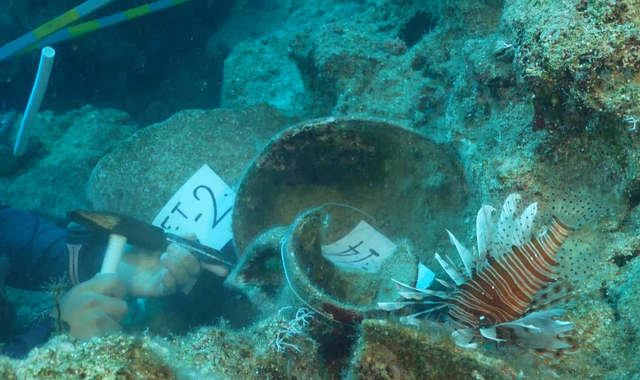
The world's oldest shipwreck has been discovered off the coast of Turkey, according to archaeologists.
It has been dated to between 4,400 and 4,700 years old and was located near Kekova island.
The wooden structure has reportedly not survived, but researchers have recovered ancient ceramic storage pots, called amphorae, that officials say provide rare insight into ancient trade routes.
Archaeologists began the underwater excavation earlier this year, with analysis of the clay suggesting the jars were probably produced in the Jordan Valley, possibly in the Early Bronze Age.
The amphorae, which were dated to about 4,400 to 4,700 years old, are believed to have been used to transport olive oil or wine.
The Great Pyramid of Giza was built about 4,580 years ago.
Similar amphorae have been found near the pyramids at Giza, Saqqara and Abusir in Egypt, as well as at Troy and on Crete, offering insights into the maritime trading connections at the time.
Researchers believe the ship may have set sail from a port on the Levantine coast and was travelling towards Troy or Crete when it sunk.
The excavation was led by associate professor Hakan Oniz, under the direction of the Antalya Museum, with permission from Turkey's ministry of culture and tourism.
Culture and tourism minister Mehmet Ersoy said: "We are uncovering traces of the world's oldest shipwreck in our blue homeland."
He added: "Clay analysis suggests that the amphorae were probably produced in workshops in the Jordan Valley.
"The discovery of similar examples in Egypt, Troy and Crete is particularly important in helping us understand the maritime trading networks that connected these regions."
Read more from Sky News:
Trump says oil search to start in Greenland
Pope Leo has 'peaceful night' after surgery
One of the amphorae recovered during the excavations has nine distinct markings and two holes in its body.
Expert analysis suggests that it may have served as a churning vessel used in the production of cheese or butter.
The find suggests that seafarers carried goats on board during long voyages, to make their own dairy products.
The wreck offers glimpses of what ancient seafarers ate and how they lived at sea, as well as what they transported.
The study was published in the Journal of Maritime Archaeology.

(c) Sky News 2026: World's oldest shipwreck found off Turkish coast, archaeologists say
 Ukrainian on trial in Germany over 'war crime' bombing of Nord Stream pipeline
 Pope thanks wellwishers for prayers after cancer operation
 Trump announces that 'massive' oil, gas and mineral exploration will begin in 'our' Greenland