

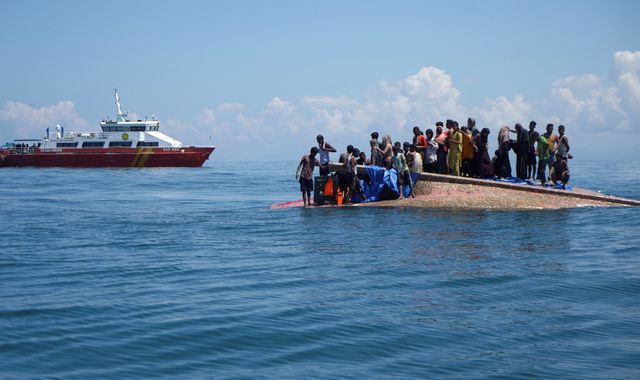
It's feared more than 500 people have died after reports that two boats carrying persecuted Rohingya refugees capsized in the Bay of Bengal.
The vessels left Rakhine state, western Myanmar, in late June, according to preliminary information from the International Organisation for Migration (IOM) and the UN High Commissioner for Refugees (UNHCR).
The passengers were mostly Rohingya, including some who had traveled from refugee camps across the border in Bangladesh.
A boat with a reported 280 people on board is believed to have sunk off Myanmar's Ayeyarwady coast on 8 July, while the other, believed to have been carrying around 250 people, lost contact shortly after departure.
In a statement, the IOM and UNHCR said that they "are gravely concerned by the potentially devastating loss of life" though "the incidents and casualty figures have yet to be officially confirmed".
Myanmar's president, its Ministry of Home Affairs, and the Ayeyarwady region's government did not respond to requests for comment.
Around 1.2 million stateless, predominantly Muslim Rohingya live in overcrowded refugee camps in Bangladesh after fleeing waves of violence by Myanmar's security forces.
They have faced "decades of discrimination and repression under successive Myanmar authorities", Human Rights Watch said on its website, calling them "one of the largest stateless populations in the world".
The estimated 600,000 Rohingya who remain in Rakhine state face persecution and violence, confined to camps and villages without freedom of movement, and cut off from access to adequate food, health care, education, and livelihoods.
Steep cuts to foreign aid by the US and other countries have exacerbated the harsh conditions.
Read more:
Falklands banner explained - World Cup latest
Star's cause of death confirmed
In recent years, thousands have tried to flee Myanmar and the squalid camps in neighbouring Bangladesh, with many dying in the process, including babies, children, and pregnant women.
But usually such boat journeys are avoided at this time of year, when monsoons are frequent and conditions at sea are particularly dangerous.
Recent torrential rain and flooding across the region would have made a crossing especially risky, the IOM and UNHCR noted.
The refugees have no way to safely return to Myanmar, where the military remains in power after killing thousands of Rohingya in 2017. The wave of violence has since been declared a genocide by the US.
Local maritime authorities have frequently abandoned the Rohingya at sea, often ignoring reports of boats in distress.
The IOM and UNHCR said the latest potential tragedy at sea underscores the continued lack of sustainable solutions for the Rohingya, and urged the international community to support those trapped in Bangladesh's camps.

(c) Sky News 2026: Hundreds of Rohingya feared dead after boats carrying refugees 'capsize' in Bay of Bengal
 Eleven children killed as fire breaks out at Algerian orphanage
 Wildfires force thousands to evacuate as skies darken over US and Canadian cities
 Former Italian motorway boss sentenced over Genoa bridge tragedy