

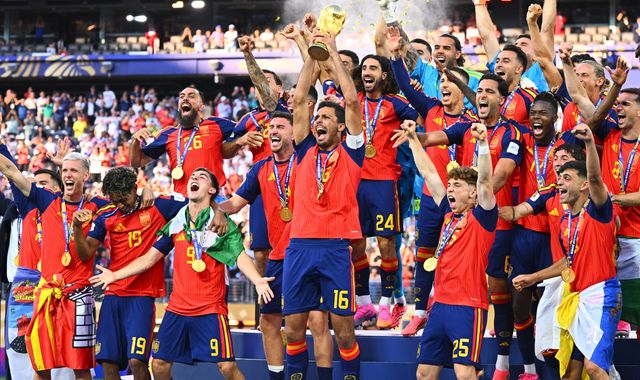
After 106 minutes, 20 shots and more than 800 passes, Spain's Ferran Torres finally opened the scoring in the World Cup final.
It was an appropriate way for Spain to claim victory, with their third 1-0 of the tournament, restricting their opponents to hardly even a chance.
The victory mirrored their last World Cup win in 2010. Spain won 1-0 in every knockout match back then, including in the final, where they also scored in the second half of extra time.
The 2026 World Cup had the most goals per game since 1970. Spain did not really buy into that, though.
They scored fewer goals than any of the other semi-finalists and only conceded once across the whole tournament. The second stat was a new record, despite there being more matches at this World Cup than ever before.
England's matches involved four goals per game on average, either for them or their opponents. Spain's games averaged fewer than two.
Individual performers
The number of goals made for the most exciting Golden Boot race in recent history, eventually won by France's Kylian Mbappe with 10 in eight matches.
Spain's Mikel Oyarzabal scored five in the tournament, but was never really involved in that race. Instead, Spain showed that having the most solid team structure is what counts at the end, more than individual brilliance.
They were the only semi-finalist with no players in the tournament's best three performers according to Sky Sports Power Rankings. But they had five in the top 10, and seven in the top 20, many more than their rivals.
Argentina's Lionel Messi was statistically the best player at the tournament overall, but the next best performer for the losing finalists was all the way down in 23rd - Manchester United's Lisandro Martinez.
The pass-masters
The statistic that perhaps best sums up Spain's team performance is the number of passes they made.
They averaged almost 600 successful passes per 90 mins on average, almost 40% more than England managed. Argentina averaged more than 500 over the whole tournament, but were restricted to 348 per 90 mins against Spain in the final.
Rodri, Spain's captain and winner of FIFA's Golden Ball trophy for best player of the tournament, made 756 passes by himself.
That's over 200 more than a player for any team other than Spain managed, and represents an average of more than one every minute he was on the pitch.
Only Argentina's Leandro Paredes - who fought with Rodri after the final whistle on Sunday - made more passes per minute.
How Spain's defence worked
Keeping the ball was crucial in Spain achieving their incredible record of letting in just one goal across the tournament. So much so, in fact, that they barely needed to resort to the traditional arts of defending.
They made fewer blocks, won fewer duels, and left their goalkeeper to make fewer saves than any of the other semi-finalists, and also won the ball in their defensive third less often.
Where they excelled was winning back possession high up the pitch, especially compared with their opponents in the final.
Messi performed incredibly when Argentina had the ball, scoring eight and setting up another four.
But having a 39-year-old leading the line may have restricted his side's ability to press from the front, putting more pressure on his teammates further back when they did not have the ball.
Meeting expectations
It's a long time now since the tournament began, so it's easy to forget that Spain did actually start as favourites.
They drew 0-0 to Cape Verde in their opening game, while France blistered their way through a tricky group and were heavy favourites by the time they met in the semi-final.
Here's the story of the whole tournament in one chart:
When it comes to England, despite the disappointing way the side dropped out, finishing third represented the country's best result since 1966.
It was also only the fourth time since 1982 that they have either met or exceeded pre-tournament expectations.
They started as third favourites to win, and after six weeks of late nights, bitten fingernails and spilled beer, they finished in third.
Only in 1990 and 2018 - England's other semi-final appearances - have they done better than what was expected of them before the tournament.
But, as in all but two cases since 1982, England were beaten by a more heavily favoured side anyway.
Italy, in both 1982 and 2006, are the only country to have gone on to win the tournament after starting it with worse odds than England.
Chances are that Spain may well be favourites again next time. They will be co-hosts in 2030, along with Portugal and Morocco.
The next time we will see them play will be Saturday 26 September, in the Nations League. That game will be at Wembley, against England.
The Data and Forensics team is a multi-skilled unit dedicated to providing transparent journalism from Sky News. We gather, analyse and visualise data to tell data-driven stories. We combine traditional reporting skills with advanced analysis of satellite images, social media and other open source information. Through multimedia storytelling we aim to better explain the world while also showing how our journalism is done.

(c) Sky News 2026: How the World Cup was won - Spain's victory in charts
 Russian warship carries out live-fire weapons exercise 46 miles off UK coast, MoD says
 Trump administration imposes 50% tariffs on Canadian goods over 'continued discrimination'
 Why last two years are worrying for future of Arctic