

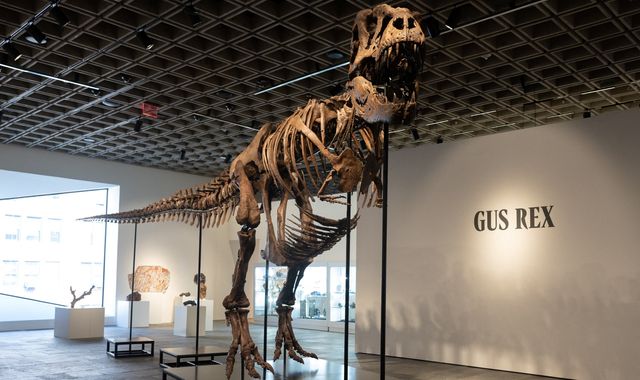
A Tyrannosaurus rex skeleton has become the most expensive dinosaur fossil sold at auction after an unidentified buyer paid more than $50m (£37.3m) for it.
The T-rex, named Gus after cattle rancher Gary 'Gus' Licking, on whose land he was found, went for $50.1m at Sotheby's in New York on Tuesday.
The 12.5 feet (3.8m)-high skeleton, with a guide price of $20m to $30m (£15m to £22m), was snapped up after a seven-way bidding contest lasting 10 minutes, Sky News' US partner NBC, said.
It's more than $5m (£3.7m) more than the $44.6m (£33.3m) hedge fund billionaire Ken Griffin paid for a Stegosaurus skeleton nicknamed Apex in 2024.
Sotheby's executive Cassandra Hatton, said in a statement: "Gus is not only an exceptional find, but a specimen that's been excavated, documented, prepared, and cared for with real excellence.
"The market responds when great specimens are taken care of in the right way."
Gus, who measures 38 feet (11m), was discovered in South Dakota and is about 67 million years old.
With 183 fossil bone elements, the skeleton is about 61% complete by bone count, making it one of the largest T-rex fossils ever found, Sotheby's said. Its skull alone is 1.4m (54 inches).
Gus' fossils were discovered by commercial palaeontologist Thomas Heitkamp, on land owned by Mr Licking in Harding County, and excavated over the course of three summers in 2021, 2022 and 2023.
After finding teeth and small bone fragments on his land, Mr Licking, who died before the dinosaur could be fully excavated, realised something bigger could be buried underneath, Sotheby's said, adding that the area is one of the richest sources of dinosaur fossils in North America.
Gus had a number of injuries, including fractured and healed bones in several ribs and gastralia - free-floating abdominal ribs- as well as bite marks to several skull bones.
Read more:
Curfew 'makes no sense'
Man found dead in suitcase
Climate change facing UK
Dinosaur fossils have become one of the hottest parts of the collectibles market, with another T-rex named Stan selling at Christie's in New York in 2020 for $31.8m ($24m), prompting fears museums are being priced out of the market.
Palaeontologist Thomas Carr said auctioning dinosaur fossils to private buyers is a "total disaster for science.
"The importance of dinosaurs are their scientific information and their beauty that the public can also appreciate.
"We're losing data. We're losing information. My fear is that this will continue and science will lose every time," he added.
The Society of Vertebrate Paleontology, an advocacy group of scientists, scholars and students, said scientifically significant fossils such as Gus should be publicly displayed in museums and other research institutions so that they can be "preserved, documented, and accessible for future generations".
Kristi Curry Rogers, the society's president-elect, said: "Our hope is that the new owner recognises the extraordinary scientific and educational value of Gus the T-rex and that they aim to keep it in the public trust by immediately donating it to an accredited natural history museum."
A juvenile dinosaur skeleton, believed to be from the late Jurassic period, about 150 million years ago, went for more than $30m at the auction house.
The Ceratosaurus nasicornis were bipeds with short arms which looked like a T-Rex, only smaller, and could grow up to 25 feet (7.6m) long.

(c) Sky News 2026: Gus the $50m T-rex breaks dinosaur fossil sale record at New York auction
 Ebola outbreak in Congo passes 2,000 cases and 750 deaths
 UK working to ban goods and services exports to and imports from Israeli settlements
 Gibraltar ushers in new era as British territory's border fence with Spain removed