

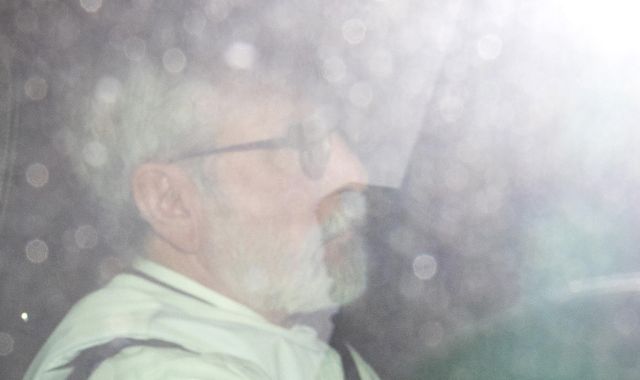
Gerry Adams was "directly responsible for and complicit" in the decisions made by the Provisional IRA to detonate bombs on the British mainland, the High Court has heard.
Three men are bringing legal action against the former Sinn Fein president and are seeking £1 in damages.
John Clark, a victim of the 1973 Old Bailey bombing in London, Jonathan Ganesh, a 1996 London Docklands bombing victim, and Barry Laycock, a victim of the 1996 Arndale shopping centre bombing in Manchester, all allege Mr Adams was a leading member of the Provisional IRA on those dates, including of its Army Council.
Mr Adams denies that he had any role in the Provisional IRA and is opposing the claim.
On Monday, he arrived at the Royal Courts of Justice in London, wearing what appeared to be a bullet-proof vest, and was driven into the car park.
The court heard the three men want to show how Mr Adams was involved in the Provisional IRA "in the course of that conflict and to show on the balance of probabilities that he was as involved as the people who planted and detonated those bombs".
Opening her case, Anne Studd KC, representing the men, said Mr Adams was "directly responsible for and complicit in those decisions made by that organisation to detonate bombs on the British mainland in 1973 and 1996".
She said they are seeking £1 in damages against Mr Adams for "vindicatory" purposes and their case is "not a focus on their injuries".
In written submissions, Ms Studd said: "The defendant carefully draws a distinction between being a member of 'the Army' and being a member of Sinn Fein.
"In reality, the evidence will demonstrate that this was not the clear either/or choice as the defendant would have you believe.
"For many individuals, we say, including Mr Adams, that was a distinction without a difference."
Read more from Sky News:
'Panic' as oil price sees biggest single-day spike in years
Masked fan unplugs VAR monitor during match
Lawyers for Mr Adams said he "played an instrumental role in the peace process which culminated in the signing of the Good Friday Agreement in April 1998, which brought an end to the decades-long conflict".
In written submissions, Edward Craven KC, representing Mr Adams, said: "The defendant's alleged factual and legal responsibility for the claimants' injuries is strongly contested, as is the claimants' ability to bring these claims against the defendant several decades after the expiry of the applicable limitation period."
He added there was "no shortage of people with an axe to grind" who sought to discredit the former Sinn Fein leader.
Mr Craven claimed British officials, members of the Royal Ulster Constabulary or other republicans opposed to the peace process had an interest in discrediting Mr Adams.
The trial before Mr Justice Swift is expected to end next week.
Speaking after the first day, Mr Adams said: "I'm here to defend myself and to challenge the allegations being made against me."
"We will let the court get on with its business. But I would like to say for the record and at the outset that the only thing that I am guilty of is being an Irish republican committed to ending British rule in our country and seeking to unite the people of Ireland on the basis of freedom, equality, peace and solidarity."

(c) Sky News 2026: Gerry Adams 'directly responsible' for bomb decisions, High Court told
 Players from Iran women's football team 'seek refuge in Australia'
 Taxpayers could fund funeral for Soham murderer Ian Huntley
 Starmer facing new Labour rebellion as MPs fight to extend porn ban